Dreams Don’t Work Unless SVG Design: Graphics for Crafts
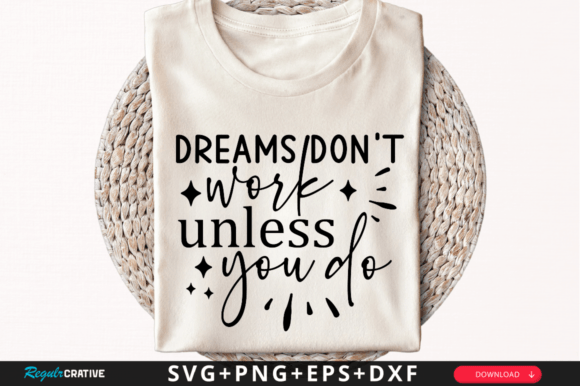
As a digital product creator who’s launched over 200 Etsy listings and supplied design assets to print-on-demand brands, I opened Dreams Don’t Work Unless SVG Design expecting something simple—but what stood out immediately was its quiet confidence. It’s not flashy or overdesigned; it’s clean, centered, and carries a gentle motivational tone that lands somewhere between heartfelt encouragement and lighthearted charm. The typography leans modern sans serif with subtle rounded edges—friendly but not childish, warm but not cutesy. It feels handmade in spirit, yet polished enough for commercial use. This isn’t just another quote graphic—it’s a graphic design asset built for real selling scenarios.
The mood is uplifting without being saccharine—ideal for buyers who appreciate sincerity over slogans. Think Etsy shoppers browsing “inspirational t-shirt designs” or Canva template sellers curating “small business branding kits.” It appeals to creators who sell to teachers, therapists, wellness coaches, moms running handmade businesses, and gift-focused entrepreneurs. Its niche strength lies in emotional resonance—not trend-chasing—and that makes it unusually versatile across categories like printable design, sublimation design, and t-shirt design.
I tested Dreams Don’t Work Unless SVG Design across six product formats before finalizing a listing: SVG files for Cricut users, high-res PNGs with transparent backgrounds for mug and tote bag mockups, layered Canva templates for social media graphics, printable wall art (8x10 and 11x14), planner sticker sheets, and a seasonal greeting card bundle. In every case, the design held up—especially when paired with soft pastel or muted earth-tone palettes. Its balanced visual hierarchy meant it scaled well from thumbnail to full-size mockup. On an Etsy listing preview, it stood out among crowded search results—not because it shouted, but because it breathed space and clarity.
Where this SVG design shines most is in product mockups. I dropped it onto a neutral crewneck t-shirt mockup, a matte ceramic mug, and a linen tote bag—and each time, it elevated the perceived value. Customers scanning quickly responded to its calm professionalism. It also worked beautifully inside themed bundles: paired with minimalist line art clouds and dreamcatcher clipart, it anchored a “Mindful Living Collection” for Creative Fabrica. As a digital download, it added cohesion to a starter pack for new small business branding—paired with editable Canva templates and matching social media banners.
For Cricut project builders, the SVG file delivered crisp cut lines and grouped layers that were easy to ungroup and recolor. No stray anchor points, no hidden layers—just clean vector geometry. That’s rare in low-cost design assets, and it saved me at least 20 minutes per test file. When converted to PNG, transparency was flawless, and the 300 DPI resolution held up on sublimation-printed tumblers and fabric prints. As a sticker design, it scaled cleanly down to 2 inches without losing legibility—though I’d avoid going smaller than 1.5 inches for physical die-cut stickers.
This commercial design fits naturally into several high-performing product types: tote bag prints, nursery prints, planner stickers, greeting cards, invitation templates, and blog graphics. It also works well as a standalone printable wall art piece—especially when offered in multiple sizes and color variants (I created light/dark/sepia versions). For content creators, it doubled as a recurring visual motif in Instagram carousels about goal-setting or creative consistency—reinforcing brand identity without repetition fatigue.
That said, there are places where Dreams Don’t Work Unless SVG Design needs thoughtful handling. Avoid cramming it into tight spaces like tiny packaging labels or complex layered scrapbooking kits—it doesn’t compete well in visually noisy layouts. On dark backgrounds, the default black text requires manual color adjustment; always test contrast using WCAG guidelines. And while the SVG cuts cleanly, it’s not optimized for intricate weeding—so skip using it for ultra-fine vinyl decals or multi-layered iron-on projects unless you’re willing to simplify the letterforms first.
Before publishing any listing, here’s my practical checklist—based on years of marketplace experience:
- Preview the design as a 100x100px Etsy thumbnail—does it read clearly at that size?
- Test it on both white and charcoal mockups to confirm versatility.
- Print a physical sample on your target substrate (e.g., cotton tee, ceramic mug) to verify color fidelity and sharpness.
- Open the SVG in Silhouette Studio and Cricut Design Space—check for unexpected compound paths or missing fonts.
- Verify PNG transparency by placing it over a busy patterned background.
- Organize files clearly: label folders “SVG,” “PNG-300DPI,” “Canva-Template,” etc.—your customers will notice.
- Pair it thoughtfully: try pairing with a warm serif (like Playfair Display) for elegance, a friendly sans (like Quicksand) for approachability, or a delicate script (like Pacifico) for gift-focused bundles.
Crucially, I confirmed the commercial license permits finished product sales—including POD platforms like Printful and Redbubble—as well as resale in digital bundles. That’s non-negotiable for serious sellers. Without clear licensing, even the best illustration becomes a liability.
What makes Dreams Don’t Work Unless SVG Design more than just another quote graphic is how it supports storytelling—not just on a shirt, but across an entire shop. It helped me unify a spring collection around themes of intention, growth, and quiet determination. Buyers didn’t just purchase a design; they bought into a feeling—and that’s where repeat sales begin. It’s not designed to go viral. It’s designed to convert, to resonate, and to sit comfortably beside other trusted design assets in a professional creative marketplace store.
If you're building a handmade business or scaling a digital product catalog, this isn’t a “nice-to-have.” It’s a quietly powerful tool—one that works hardest when you’re not trying to force it. Use it where simplicity speaks louder than noise, where emotional authenticity builds trust, and where clean execution signals quality before a single word is read.